Machine learning (ML) models run on massive datasets and often perform billions of floating-point calculations.
But here’s the problem: small numerical errors can snowball into completely wrong predictions — and sometimes, you won’t even see a NaN or an error message.
This is numerical instability, and it’s sneaky.
In our FSE 2025 paper, we introduce Soft Assertions — a new approach to detect and trigger these hidden bugs automatically.
🔍 Why Numerical Instability Matters
Numerical bugs in ML can:
- Crash your application (NaN / INF errors)
- Quietly corrupt predictions without warning
- Waste hours of compute on doomed training runs
Example:
In one case study, a brain tumor detection model trained on MRI scans predicted “no tumor” when a tumor was clearly present — all because of an unstable function deep inside a neural network layer.
💡 What Are Soft Assertions?
Think of soft assertions as learned runtime guards for ML code.
Instead of writing a rigid assert statement, we train a small ML model to recognize “dangerous” input values for certain functions — like cosine_similarity, exp, or matmul.
When the program runs:
- The soft assertion checks the inputs at a numerically unstable function.
- If instability is likely, it tells the fuzzer how to mutate the inputs to trigger the bug.
This is different from:
- Static analysis (can’t always handle high-dimensional tensors)
- Hard-coded assertions (hard to write for complex math)
- Random fuzzing (slow to find the right edge cases)
🛠️ How It Works
- Build a database of unstable ML functions (we found 61 in PyTorch & TensorFlow).
- Design oracles to decide if a function’s output is wrong (NaN/INF, out of range, wrong value, etc.).
- Generate training data by running unit tests on these functions.
- Train a classifier (we used Random Forest) to predict:
increase→ increasing the value will cause instabilitydecrease→ decreasing will cause instabilityno change→ this input already causes instability
- Guide fuzzing using these predictions to reach instability faster.
📊 Key Results
We tested our Soft Assertion Fuzzer on:
- 79 benchmark ML programs with known bugs (GRIST dataset)
- 15 real-world GitHub projects
Findings:
- Detected all 79 benchmark bugs
- Found 13 previously unknown bugs in real-world code
- Worked faster than 5 state-of-the-art fuzzers
🧠 Case Study: Tumor Detection Model
- Model: TumorScope (brain MRI classification)
- Problem: Vanishing gradient caused by GlorotUniform weight initialization in
Conv2D - Effect: Important features erased → wrong “no tumor” prediction
- Fix: Switched to stable
he_normalinitialization → correct “tumor” prediction
Before fix:
Confidence in “no tumor” = 0.4990
After fix:
Confidence in “tumor” = 0.8874
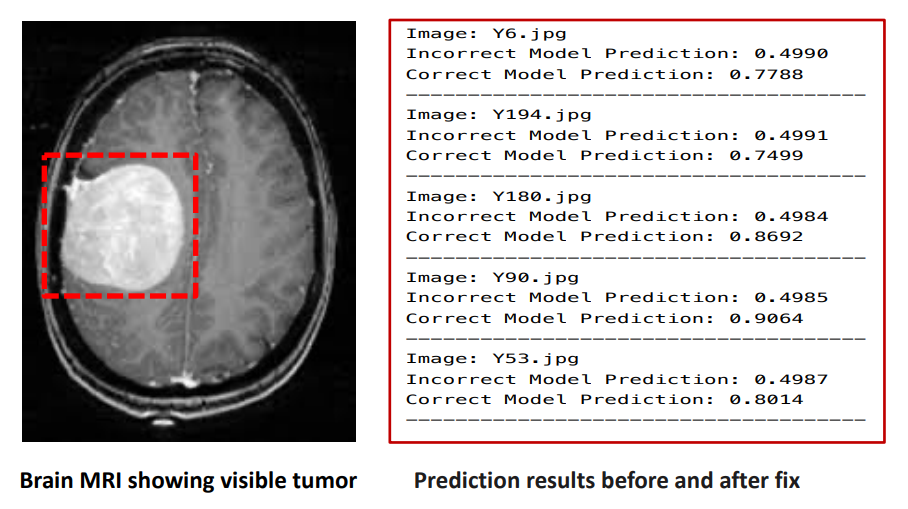
Figure: Left — before fix, model incorrectly predicted “no tumor”; Right — after fix, correct “tumor” prediction.
🚀 Why This Matters
Soft Assertions bridge a gap between:
- Formal verification (too rigid for real ML workloads)
- Pure fuzzing (too slow for targeted bugs)
They let developers:
- Detect silent ML failures
- Get actionable guidance on triggering bugs
- Extend the system to new unstable functions
📄 Read the full paper:
Automatically Detecting Numerical Instability in ML via Soft Assertions (FSE 2025)
💻 Source code:
Soft Assertion Fuzzer on GitHub